- - Rep. AHN DOGEOL and Chairman WOO JUNGKWON: “K-content will expand its global financial territory through STO legislation”
- - Musicow Chairperson JUNG HYUNKYUNG: “Music copyright is an independent asset unaffected by macroeconomic conditions…Institutional obstacles must be urgently resolved”
- - Hanteo Global CEO KWAK YOUNGHO: “Simple liquidation-type fractional investment has limitations…KCPI-based valuation and building a full-cycle ecosystem are the essence”
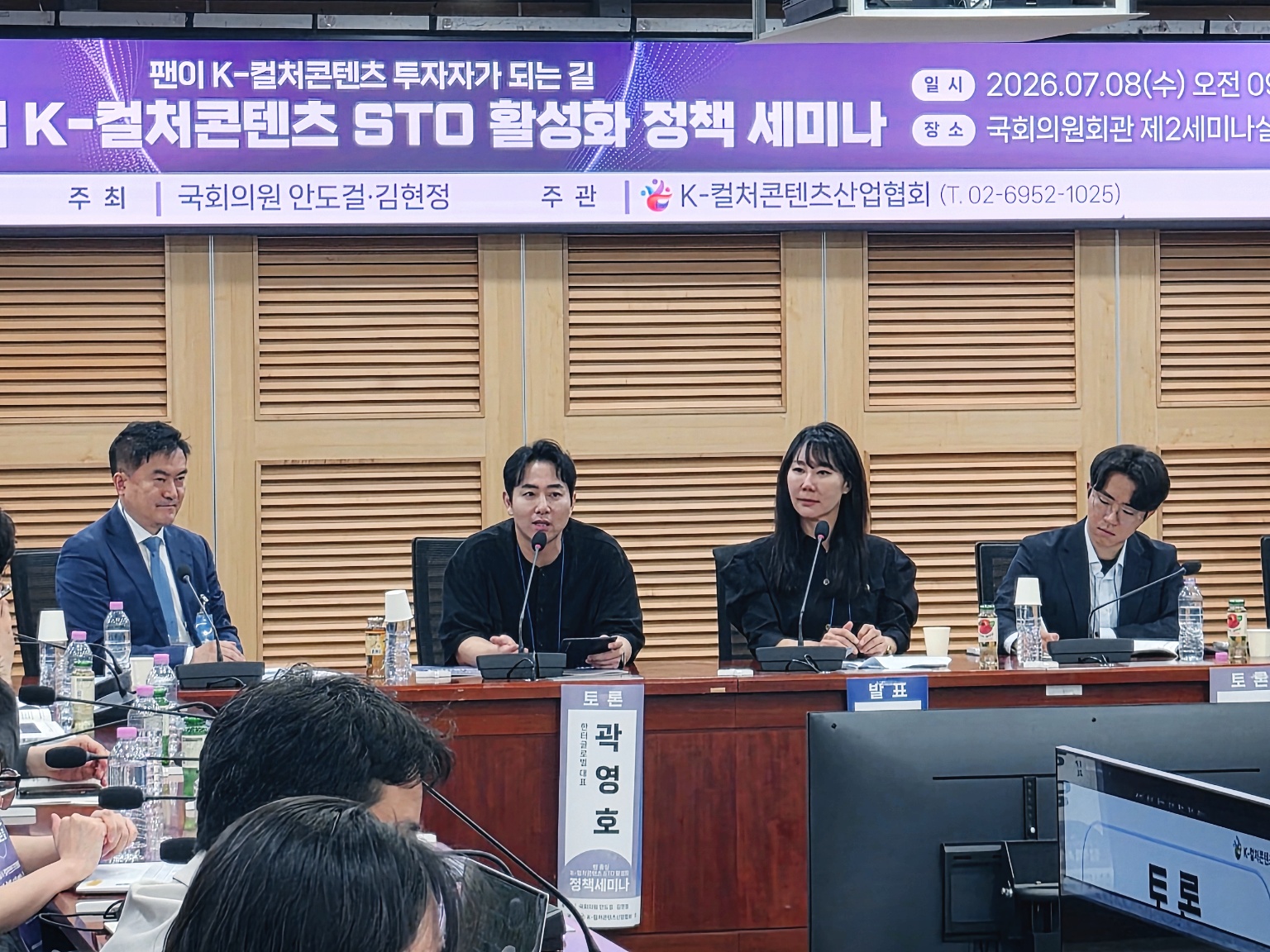
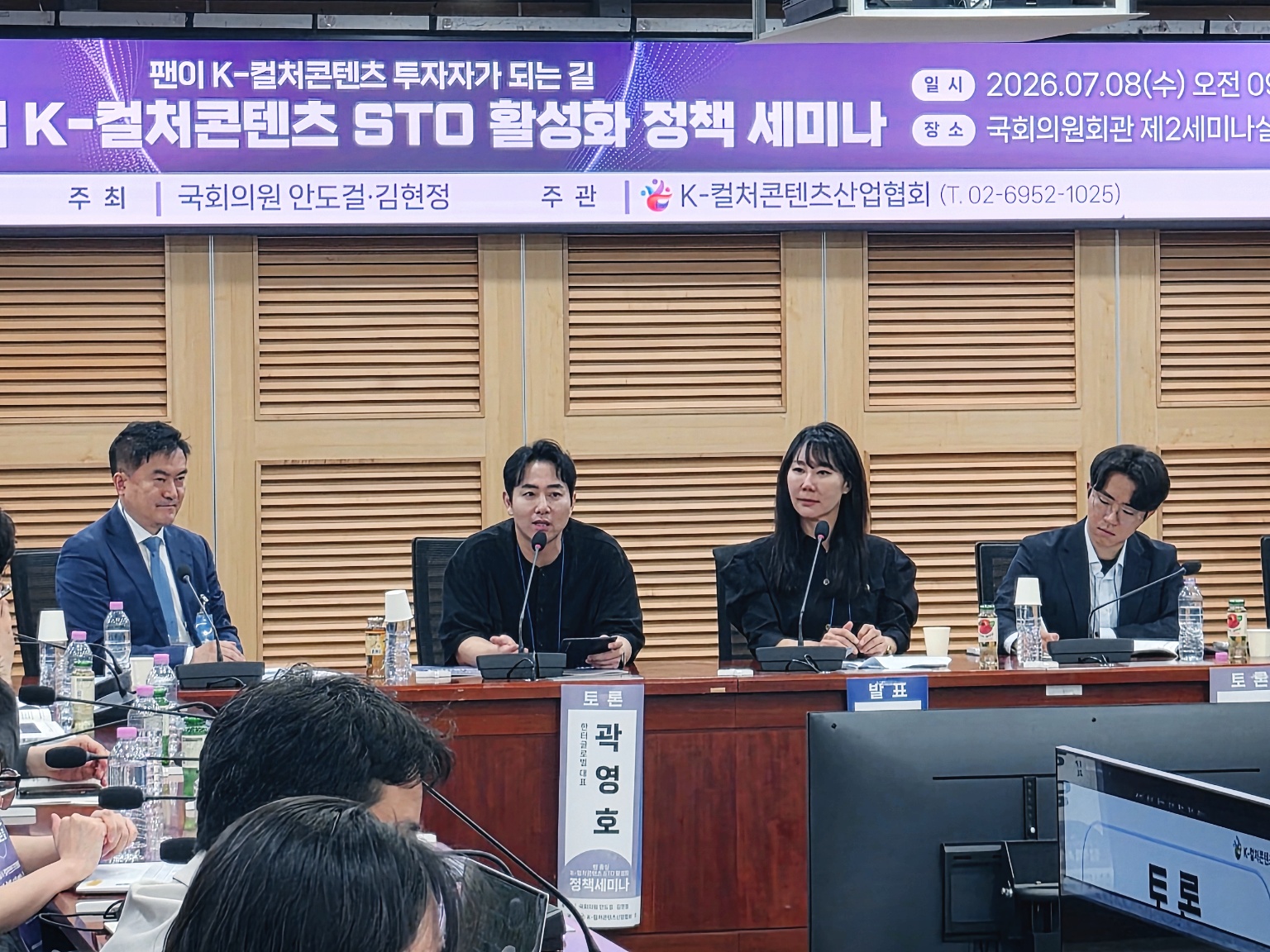
A large-scale forum involving the political, governmental, academic, and industrial sectors was held to explore the global cultural finance market by combining K-culture content IP (intellectual property) with security token offerings (STO). In particular, KWAK YOUNGHO, CEO of global K-pop big data company Hanteo Global, drew attention by sharply pointing out the limitations of existing STO models and bringing “full-cycle ecosystem-type STO” and a new valuation standard to the forefront.
On the 8th, the “Policy Seminar on Activating Fan-Centered K-Culture Content STO,” co-hosted by the offices of Democratic Party lawmakers AHN DOGEOL and KIM HYUNJUNG and organized by the K-Culture Content Industry Association, was held in Seminar Room 2 of the National Assembly Members’ Office Building in Yeouido, Seoul. The seminar was prepared to diagnose the financialization potential of K-content and broadly address institutional tasks for introducing STO, including valuation, rights and investor protection, and overseas issuance infrastructure.
◼︎ National Assembly and Academia: “The Integration of K-Content and Finance Requires Swift STO Legislation”
Rep. AHN DOGEOL, who hosted the seminar, expressed strong support in a written congratulatory address, saying, “For the sustainable growth of K-culture, it is essential to create an environment for the liquidation of content IP and establish investor protection measures.” He added, “Based on the alternatives derived from this seminar, I will spare no effort at the National Assembly level to swiftly pass amendments to the Capital Markets Act and the Electronic Securities Act for STO legislation and to improve related guidelines.”
In his opening remarks, WOO JUNGKWON, chairman of the K-Culture Content Industry Association and professor at Dankook University, diagnosed the situation by saying, “Although K-content has secured a global status, the structure of production financing and profit distribution still remains in an analog format.” He shared his ambition, saying, “Blockchain-based STO will open an era of ‘fan-centered cultural finance’ in which fandoms directly participate as investors and drive the growth of the industry.”
◼︎ Musicow Chairperson JUNG HYUNKYUNG: “Music Copyright Is an Independent Asset Class…Regulatory Issues Such as the Ban on Double Trusts Must Be Resolved”
JUNG HYUNKYUNG, chairperson of Musicow, who was the first presenter, emphasized the asset value of music copyright and the urgency of easing on-site regulations. Chairperson JUNG stressed, “Music copyright is an independent asset class that generates stable cash flow and has a correlation close to zero with macroeconomic indicators such as stocks, bonds, and commodities.”
However, Chairperson JUNG said, “Since the current Copyright Act and Capital Markets Act were not designed with their combination in mind, IP financial liquidation is facing legal obstacles,” pointing to the “ban on double trusts” clause as a representative regulatory barrier. She added, “It is currently being temporarily permitted through innovative financial services, but for the sustainability of the market, it is urgent to reorganize rights relationships with collective management organizations and complete the relevant laws and regulations.”
◼︎ Hanteo Global CEO KWAK YOUNGHO: “Regulatory Easing Alone Is Not Enough…We Must Move Beyond the Limits of Liquidation-Type Fractional Investment”
KWAK YOUNGHO, CEO of Hanteo Global, who was the second presenter, cut into the issue by saying, “We must move away from the one-dimensional, supplier-centered logic that the market will grow explosively if only regulations are eased.” CEO KWAK said, “K-pop and the fandom economy do not operate as simply as ordinary financial products,” directly raising the structural limitations of existing STO models.
CEO KWAK pointed out the dilemma of the so-called “liquidation-type fractional investment” method, which divides and sells the music revenue of already released songs. His analysis was that actual streaming revenue is difficult to meet public expectations unless it comes from a mega hit song, while mega hit songs by major agencies have little financial incentive to be released to the market in the form of fractional investment. Ultimately, adverse selection occurs in the market, with mainly non-hit songs being supplied, making it difficult to draw participation from global fandoms.
As a solution, he emphasized, “True value creation is possible only when we move toward a ‘full-cycle ecosystem-type STO’ in which data, real-world infrastructure, and global stablecoin payments are organically integrated from the planning stage through activities and global expansion.”
◼︎ New Valuation Standard “KCPI” and National Project Covering Seven Major Content Fields
CEO KWAK proposed that a new evaluation system analyzing the entire range of fandom activities is needed to read the true value of K-pop. To this end, he presented the unrivaled big data infrastructure of Hanteo Chart, which Hanteo Global has accumulated since the early 1990s, as the foundation for a new cultural finance standard. It is a system that comprehensively analyzes global fandom behavior pattern data, including not only physical album sales, but also digital music, social media, portals, authentication, and secondhand transactions.
In particular, as part of a large-scale project by the Ministry of Culture, Sports and Tourism, Hanteo Global is currently building a “Comprehensive Hallyu Influence Evaluation Model” platform that will cover seven major content categories, including music, films, dramas, webtoons, games, books, and publishing, by 2028.
The key service at the center of this is “KCPI (K-Culture Power Index).” By integrating fragmented cultural data and providing an index that can be verified and predicted at the global market level, the strategy is to establish it as the most authoritative standard in the future cultural finance market.
◼︎ Government Ministries: “We Will Support STO Legislation and Market Activation on the Premise of Investor Protection”
In the discussion that followed, officials from government ministries stated that they would actively support the activation of cultural content STO while making investor protection measures a prerequisite. LEE HANJIN, an official from the Financial Services Commission, said, “The essence of introducing STO is to make it possible to securitize various assets, such as fractional investments that were difficult to issue in the past, through the technology of tokens.” He added, “We will improve systems that establish stable market infrastructure and protection measures so that investors can participate with confidence, while also working closely with the National Assembly for legislative institutionalization, including the passage of amendments to the Capital Markets Act.”
CHOI EUN, an official from the Ministry of Culture, Sports and Tourism, said, “K-content IP is a core asset with global competitiveness, but there have been many difficulties in raising funds due to the limitations of valuation in traditional financial circles.” She added, “Through organizations such as the Korea Creative Content Agency, we will continue to advance the ‘content valuation model’ that combines quantitative and qualitative evaluation, and strengthen the policy support system so that funds can be smoothly supplied to creators and production companies through STO.”
◼︎ “Fan Love Becomes an Asset”…A New Era of Cultural Finance Foreshadowed
In conclusion, CEO KWAK YOUNGHO suggested, “As the emotions, participation, and cultural ripple effect of a moving fandom become the value of an asset, flexible institutional design that deeply understands the unique characteristics of K-culture is needed in the process of STO legislation.” He also expressed Hanteo Global’s ambition to contribute to establishing standards in the global cultural finance market through KCPI.
Industry officials evaluated the seminar as a meaningful occasion that went beyond a technical discussion on turning cultural IP into financial products and sought fundamental solutions to how the financial system should interpret and embrace the “dynamism of the fandom economy.”
![At the Crossroads of an “11-Year Partnership,” TWICE…JYP’s Contract Renewal Calculus [HT Focus]](/_next/image?url=https%3A%2F%2Fresource.hanteonews.com%2Fcontent%2Fpost%2F2026%2F08%2F12%2F35b97dc0-8727-41b1-8c42-90749efe4645.jpg&w=3840&q=75)
![JYP Says “Xdinary Heroes’ GUNIL, Contract Terminated” [Full Statement]](/_next/image?url=https%3A%2F%2Fresource.hanteonews.com%2Fcontent%2Fpost%2F2026%2F08%2F13%2F532535e9-b4c9-4602-b28d-1f1f1afbecb5.jpg&w=3840&q=75)

![CORTIS’ First Solo Concert: Why You Shouldn’t Miss It [HT Focus]](/_next/image?url=https%3A%2F%2Fresource.hanteonews.com%2Fcontent%2Fpost%2F2026%2F06%2F02%2Fc9d8ced1-b9de-4d0a-bf27-333f17155ccd.png&w=3840&q=75)
![Why He Chose JYP in the First Place…GUNIL Faces Backlash From “Truth, Sincerity, and Humility” [HT Focus]](/_next/image?url=https%3A%2F%2Fresource.hanteonews.com%2Fcontent%2Fpost%2F2026%2F08%2F14%2F912fd3c1-3385-4ee4-8dc4-915094e1532a.jpg&w=3840&q=75)