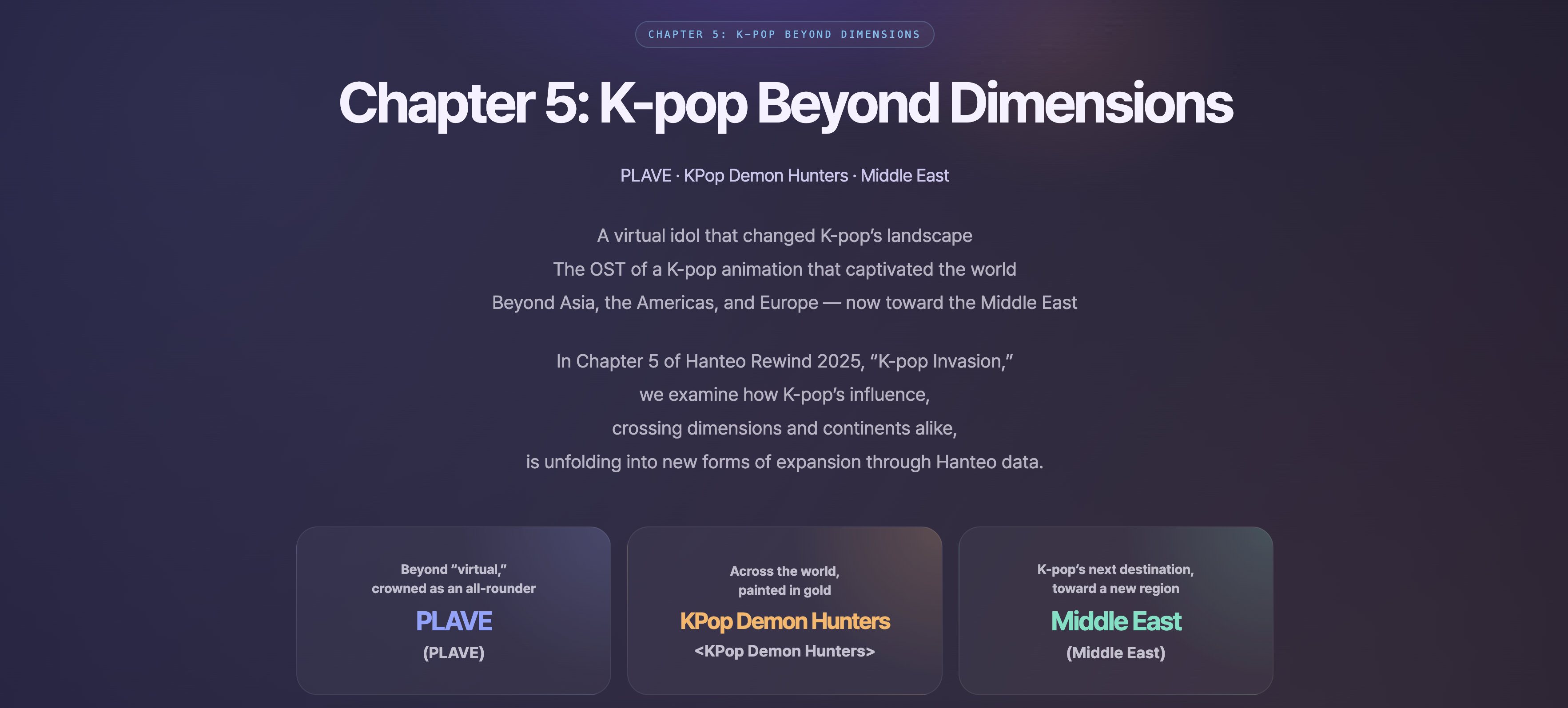
In 2025, K-pop has reached a stage where it can no longer be explained simply by success in certain countries or the overseas achievements of a few teams. Virtual idols have entered major concert venues, animation OSTs have shaken global charts, and the Middle East is rapidly establishing its presence as a new market. Chapter 5 of Hanteo Chart’s annual report, Hanteo Rewind, shows exactly how these changes are being proven through data.
The fifth chapter of Hanteo Rewind, released on the 1st, compiles and spotlights 2025 data on PLAVE and KPop Demon Hunters.
What makes this chapter particularly interesting is that it does not frame the expansion of K-pop through the familiar expression of “overseas expansion.” The axis of expansion no longer stops at countries and continents. It is simultaneously crossing the boundaries between reality and virtuality, stage and screen, established core markets and emerging ones. K-pop has become not only an industry moving into broader spaces, but also one beginning to exist in more diverse forms.
While Chapters 3 and 4 previously examined the markets of the Americas and Asia through the lenses of “dominance,” “localization,” and “growth structure,” Chapter 5 goes a step further. It is less about which countries K-pop is strong in, and more about how K-pop is redefining itself through new formats, new platforms, and new markets.
► PLAVE: 2.35 Million Sales and a Gocheok Dome Debut That Erased the Limits of the Virtual

The first thing that stands out is PLAVE’s growth curve. In 2025, PLAVE recorded total album sales of 2,353,570 copies. Their 3rd mini album Caligo Pt.1 and 2nd single album PLBBUU each surpassed 1 million first-week sales, making them back-to-back million-sellers in first-week sales. This shows that they can no longer be explained merely by the novelty of being a “virtual idol.” PLAVE is now being evaluated as a team that has proven real purchasing power and fandom cohesion in the mainstream idol market.
The detailed figures are equally clear. Of PLAVE’s 2025 album sales, PLBBUU accounted for 48.6% and Caligo Pt.1 for 47.1%. In effect, those two albums drove the overwhelming majority of the group’s annual sales performance. Their albums also reached fans in 20 countries, indicating that their expansion can no longer be seen as the result of domestic fandom alone.
Their digital performance was also impressive. In 2025, PLAVE recorded an annual Hanteo digital score of 2,969,985 points, ranking 6th among all artists. The numbers reveal a tightly knit fandom that continues consuming not only new releases but also previous songs and earlier albums whenever a new release drops. Virtual artists are often discussed in terms of buzz or lore, but in PLAVE’s case, their 2025 performance shows that they have firmly established themselves as an IP with actual consumer power in both physical albums and digital music.
Their concert achievements were even more symbolic. In 2025, PLAVE held 12 performances across six Asian cities—Seoul, Taipei, Hong Kong, Jakarta, Bangkok, and Tokyo—drawing a total audience of 126,018. Then in November, they became the first virtual artist to hold a solo concert at Gocheok Sky Dome. With approximately 33,000 attendees over two days, the event was not just a successful technical experiment; it proved that virtual artists can generate enough ticket power to fill major venues.
What deserves even more attention is the scale of their growth. Starting from roughly 4,904 seats at Olympic Hall in 2024, PLAVE expanded to 33,488 seats at Gocheok Sky Dome in 2025—about a 6.8-fold increase. A jump of that magnitude suggests more than simple fandom growth; it means the industry’s very way of accepting this team has changed. Ultimately, PLAVE’s 2025 was not merely proof that “virtual can work,” but close to a declaration that virtual artists have already entered the core grammar of the K-pop industry.
► KPop Demon Hunters: A Global Phenomenon Worth 7.83 Million Points That Exploded Beyond the Stage

KPop Demon Hunters symbolically demonstrated that K-pop is no longer consumed only through artists on stage. The seven OST tracks from the work recorded a combined annual Hanteo digital score of 7,836,406 points in 2025. Starting from 29,274 points at the time of release in June, the score soared to 1,809,674 points by August. That 61.8-fold increase shows that this was more than temporary virality—it reflects global mainstream consumption translating into real numbers.
At the center of it all was, without question, “Golden.” As a single track, “Golden” recorded 1,827,935 points, accounting for 23% of the OST’s total score. On Hanteo’s U.S. country chart, it ranked No. 1 for 10 consecutive weeks from the second week of September through the third week of November 2025, charting a total of 26 times. It also ranked No. 1 for six consecutive weeks on the China chart and maintained a long-charting trajectory in Japan. In other words, a single animated OST reshaped global consumption patterns for K-pop.
These numbers matter because the success of KPop Demon Hunters cannot be explained simply as the popularity of one song. It revealed how powerful a content IP can become when characters, world-building, storytelling, and platform distribution come together with K-pop sensibilities. K-pop is no longer just a stage-centered industry where artists and fandoms meet directly. It is now evolving into an industry capable of creating the same level of immersion and consumption through screens, narratives, and characters.
Its achievements were also reflected in award-season momentum. KPop Demon Hunters drew attention from organizations such as the Korean Association of Film Critics Awards and the Chicago Critics Association Awards, and later posted meaningful results at major ceremonies including the Golden Globes, Critics Choice Awards, the Academy Awards, and the iHeartRadio Music Awards. This shows that K-pop is not only strong within the music market, but can also be persuasive on the global stage when combined with the screen-content industry.
In the end, KPop Demon Hunters leaves one big question: Is the true body of K-pop the stage, or is it any form of content capable of carrying its sensibility? The data from 2025 points much more strongly to the latter. If even stories that begin outside the stage can shake global charts and awards ceremonies, then K-pop’s reach has already gone beyond the level of a mere genre.
► The Middle East Is No Longer a Periphery... K-pop’s “Next Destination”
In terms of regional expansion, another key takeaway from Chapter 5 is the Middle East. The report points out that the Middle Eastern market, centered on Saudi Arabia and the United Arab Emirates (UAE), is emerging as both K-pop’s “next destination” and a “major growth hub.” Scenes that once looked like symbolic visits by a handful of top artists are now settling into a repeatable ecosystem of concerts and events.
The starting point of this trend was 2019. In July of that year, Super Junior held the first solo concert in Saudi Arabia by an Asian artist, and in November BTS also staged a solo concert there. Once major artists paved the way, the nature of the market began to change rapidly. The Middle East was no longer seen as an unfamiliar test stage, but as a new region where K-pop could prepare for its next phase of growth.
The pace of expansion accelerated even more after the pandemic. KCON 2022 SAUDI ARABIA featured 12 teams including ATEEZ and NewJeans, while KCON SAUDI ARABIA 2023 included 10 teams such as RIIZE and OH MY GIRL. That same year, 2023 Hyperound K-Fest also featured seven teams including ENHYPEN and Sunmi. What matters is that this is no longer about a single large-scale event, but about multiple K-pop events of different kinds unfolding in succession.
By 2025, the momentum had become even more pronounced. The KOREA360 promotional center opened in Dubai, followed by events such as 2025 K-EXPO UAE and DREAM CONCERT 2025 in Abu Dhabi. A wide range of artists—including SEVENTEEN, ATEEZ, (G)I-DLE, members of Red Velvet, Billlie, and Chen—created points of contact with Middle Eastern stages. This shows that the region is no longer a symbolic stage accessible only to a handful of top-tier stars, but a realistic market being strategically considered by a broad range of teams.
The significance of the Middle Eastern market cannot be reduced to a single number, and that is precisely why it matters. The region simultaneously offers geographical connectivity linking Asia, Europe, and Africa, infrastructure well-suited for large-scale events, and the potential to become a gathering point for new global fandoms. That is why Hanteo Rewind Chapter 5 treats the Middle East as a distinct axis. K-pop is no longer just reinforcing its strength in established core markets; it is also building its own industrial grammar in entirely new regions that have yet to be fully defined.
► K-pop in 2025: Beyond Crossing Borders, Toward Redefining Its Form
Ultimately, the conclusion presented by Hanteo Rewind Chapter 5 is clear. PLAVE broke down the boundary between reality and virtuality; KPop Demon Hunters erased the line between stage and screen; and the Middle East proved that K-pop’s industrial grammar remains valid even outside its traditional core regions. These may seem like different cases, but together they point in one direction: K-pop is no longer an industry that simply repeats familiar formulas for success, but one that is actively creating new playing fields for itself.
K-pop in 2025 did not simply move into wider spaces. It began to exist in more ways. The scaling up of virtual idols, the global success of content-IP-based music, and the opening of the Middle East as a new market all show that K-pop’s future rests not on a single route, but on multilayered expansion.
The next stage of K-pop can no longer be explained merely by which countries it reaches. What matters more now is which dimensions it expands into, on which platforms it creates fandom and consumption, and in which markets it establishes new orders. And the data from 2025 suggests that this change has already begun—or perhaps has already progressed much further than expected.
![&TEAM MAKI Says, “I Want to Perform at Lollapalooza… I Think We Would Fit Well” [HT Scene]](/_next/image?url=https%3A%2F%2Fresource.hanteonews.com%2Fcontent%2Fpost%2F2026%2F09%2F08%2F80cc55e1-21c0-441a-8aef-01e50ce0bec2.jpeg&w=3840&q=75)
![At the Crossroads of an “11-Year Partnership,” TWICE…JYP’s Contract Renewal Calculus [HT Focus]](/_next/image?url=https%3A%2F%2Fresource.hanteonews.com%2Fcontent%2Fpost%2F2026%2F08%2F12%2F35b97dc0-8727-41b1-8c42-90749efe4645.jpg&w=3840&q=75)
![Why a Festival Bearing Stray Kids’ Name Is Being Held in Latin America [HT Focus]](/_next/image?url=https%3A%2F%2Fresource.hanteonews.com%2Fcontent%2Fpost%2F2026%2F06%2F23%2F3b0eaa19-22e7-4397-9c6b-ef7cbb48597d.jpg&w=3840&q=75)

![Why Tens of Thousands Gather for Virtual Concerts…What PLAVE Has Proven [HT Focus]](/_next/image?url=https%3A%2F%2Fresource.hanteonews.com%2Fcontent%2Fpost%2F2026%2F06%2F04%2F75061ea6-136a-4c0e-8328-38ca02333afb.png&w=3840&q=75)