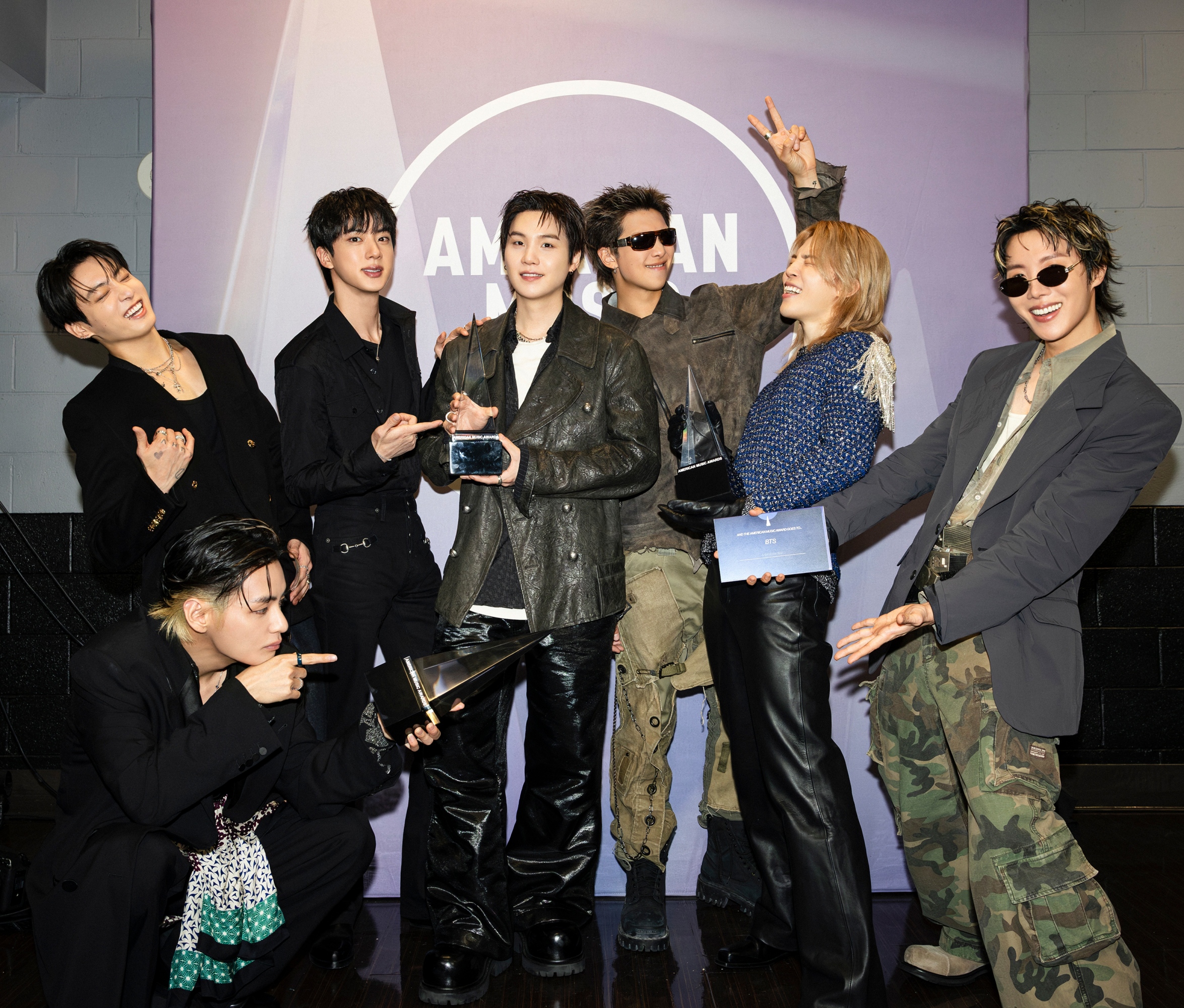
Is fan voting a factor that undermines the credibility of music awards? On the day BTS won their second grand prize at the ‘American Music Awards (AMA)’ on the 25th (local time), this question resurfaced once again.
On this day, BTS won ‘Artist of the Year,’ considered the grand prize, at the AMA held at the MGM Grand Garden Arena in Las Vegas, U.S. Following their win in 2021, this marked their second time receiving the award, making them one of only four teams in history to win the category more than once. It came right after they returned from a hiatus of about 3 years and 9 months due to military service.
Regarding this win, some raised questions about its credibility, citing the fact that it is a “fan-voted awards show.” However, looking into the structure of the AMA tells a different story. The AMA strictly separates nominee selection from winner determination. Nominees are selected based on objective data compiled by Billboard and Luminate, including streaming, album and music sales, radio airplay, and tour revenue, while only the winners are decided by fan voting. Criticism that “its credibility is low because it is fan-voted” only looks at half of this structure.
Then is the fan-voting system really a weakness? It can be viewed as the opposite. This is because the way today’s music industry operates is itself driven by organized fan participation. Fans consume artists’ music and directly contribute to chart performance in highly organized ways, such as streaming parties, social media campaigns, and TikTok challenges. Spotify Wrapped 2024 selected K-POP as the most-streamed genre worldwide, which serves as evidence that organized fandom streaming movements actually move music consumption indicators. In a structure where the size and loyalty of a fandom are directly connected to an artist’s commercial influence, fan voting is the most direct way to measure that influence. There is room for counterargument in that organized fandom influence during the Turbo Voting period played a role in this year’s AMA as well. However, given that such organized movement itself is the essence of music consumption in this era, the AMA is closer to an awards show that reflects the times most honestly.
At this point, the comparison with the Grammys becomes meaningful. The Grammys have long faced criticism for being “a party only for industry insiders.” A representative example is the 2023 ceremony. Although BEYONCÉ is the most-awarded artist in Grammy history, she failed to win Album of the Year four times in a row. In 2023, she was widely expected to win with ‘Renaissance,’ but lost to HARRY STYLES, which once again sparked criticism that the Grammys prioritize industry standards over the public’s actual consumption trends. In contrast, the AMA was designed from the beginning as an awards show that measures public music consumption. When asking which side reads the actual landscape of today’s music industry more accurately, the AMA’s answer is clear.
BTS’s latest win can be read in that context. The ‘Artist of the Year’ chosen directly by fans is proof that even after a 3-year-and-9-month hiatus, the loyalty of their fandom has not been diluted at all. The trophy they won over formidable competitors such as BAD BUNNY, BRUNO MARS, TAYLOR SWIFT, and HARRY STYLES says exactly that.
If the standard of credibility is “who votes,” the AMA is an awards show with weaknesses. However, if the standard is “how music is consumed today,” the AMA is the most honest awards show. BTS’s return proved that.
![[Daily Ranking: May 17th] NMIXX’s ‘Heavy Serenade’ Places 1st](/_next/image?url=https%3A%2F%2Fhanteoresource.s3.ap-northeast-2.amazonaws.com%2Fhanteonews%2Farticle%2Fthumbnail%2Fbot%2Fchart%2Falbum%2Fdaily%2Fen%2F1st.png%3Fv0.0.1&w=3840&q=75)


