- - From Japan to Greater China to Southeast Asia… The expansion of K-pop girl groups proven by numbers
- ‘Foreign members’ are no longer symbolic… The winning formula of female K-pop artists in 2025
On a tightly connected fandom landscape spanning Japan, Greater China, and Southeast Asia, K-pop girl groups have evolved beyond simply being popular acts to becoming central pillars of an industry that precisely designs cultural touchpoints in each region.
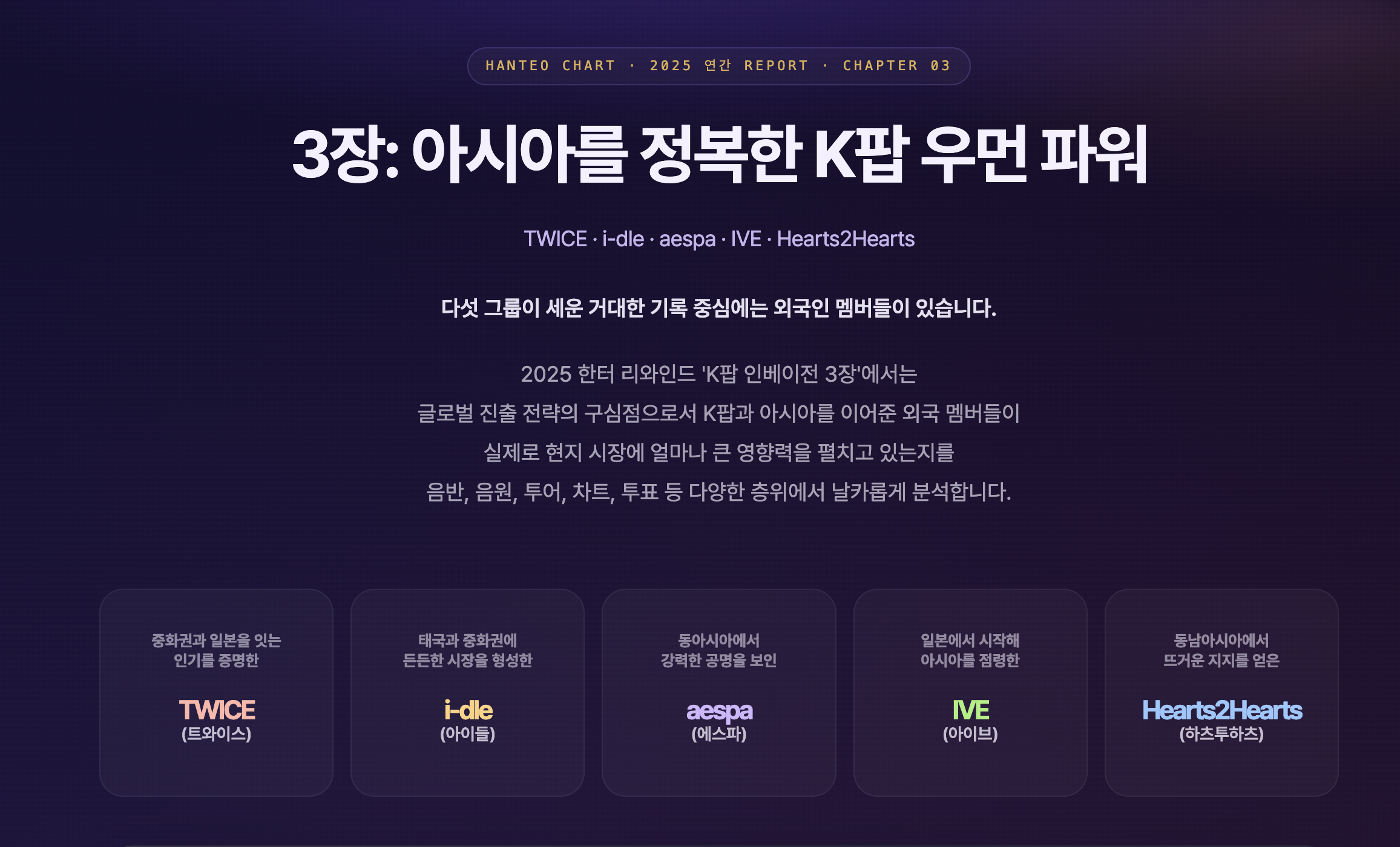
The third chapter of Hanteo Chart’s annual report ‘Hanteo Rewind,’ released on the 17th, titled ‘K-pop Woman Power Conquering Asia,’ examines the growth and achievements of female K-pop artists in 2025 through data.
What makes this report particularly interesting is that it no longer treats the presence of foreign members as merely symbolic. They are no longer decorative elements representing global identity, but key drivers that lead fandom consolidation and actual consumption in specific regions.
For TWICE, Japanese and Greater Chinese members translated into massive ticket power, while for i-dle, Thai and Greater Chinese members formed core album sales markets. aespa and IVE demonstrated balanced growth across Japan, Greater China, and Asia as a whole, while Hearts2Hearts showed how Southeast Asia embraces the next generation of mega rookies.
► 910,000 audience concentration… TWICE’s ‘ticket power’ connecting Japan and Greater China

The most defining keyword for TWICE remains ‘live performance dominance.’ In 2025, TWICE attracted 918,704 audience members across 29 concerts in 15 cities in 11 countries. Of these, about 78.8%—724,209 people, were concentrated in Japan and Greater China. This clearly shows not just the size of their fandom, but where their mobilizing power is strongest.
This success is closely tied to their member composition. The Japanese-member unit MISAMO drew 98,000 fans to Tokyo Dome, while Tzuyu’s presence led to performances at Kaohsiung National Stadium in Taiwan. TWICE is not just a group loved across Asia, but one that has created the sense of being “our team” in each region. Their 2025 album sales of 1,136,367 copies across 96 countries further reflect both the breadth and density of their fandom.
Having dominated Asia in 2025, TWICE is continuing its global expansion this year with a large-scale North American tour.
► 81.7% of sales concentrated in Thailand and Greater China… i-dle expands member narratives into markets

i-dle’s strength lies in how each member’s cultural background directly connects to the group’s performance. According to the report, 81.7% of their overseas album sales came from Thailand and Greater China. Members Minnie, Yuqi, and Shuhua are not just symbols of global identity, but key drivers transforming local fandom into real purchasing power.
Their achievements are clear. In 2025, i-dle recorded 1,837,433 album sales on Hanteo and won the Grand Prize in the digital music category at the 32nd Hanteo Music Awards. They also made history as the first K-pop girl group to sell out Taipei Dome. Their 2025 stands as a representative example of how a ‘global member composition’ can become a powerful regional expansion strategy.
► 9.73 million digital score… aespa completes balance across music, albums, and tours

aespa was one of the most balanced-performing girl groups in 2025. With hits like ‘Whiplash’ and ‘Supernova,’ they recorded a Hanteo digital score of 9,730,229 and album sales of 2,099,941 copies. This clearly demonstrates a structure where both public appeal and fandom power operate simultaneously.
Their tours were equally notable. aespa attracted 405,544 fans across 35 concerts in 21 cities. Japan accounted for a significant portion of their schedule, and 64.7% of overseas album sales came from Japan and Greater China. The presence of Japanese member Giselle and Chinese member Ningning contributed to the group’s expansion and market adaptability.
aespa’s 2025 marks their evolution from a ‘strong concept group’ to a major IP dominating music, albums, and performances.
► 2.46 million sales… IVE expands across Asia via Japan
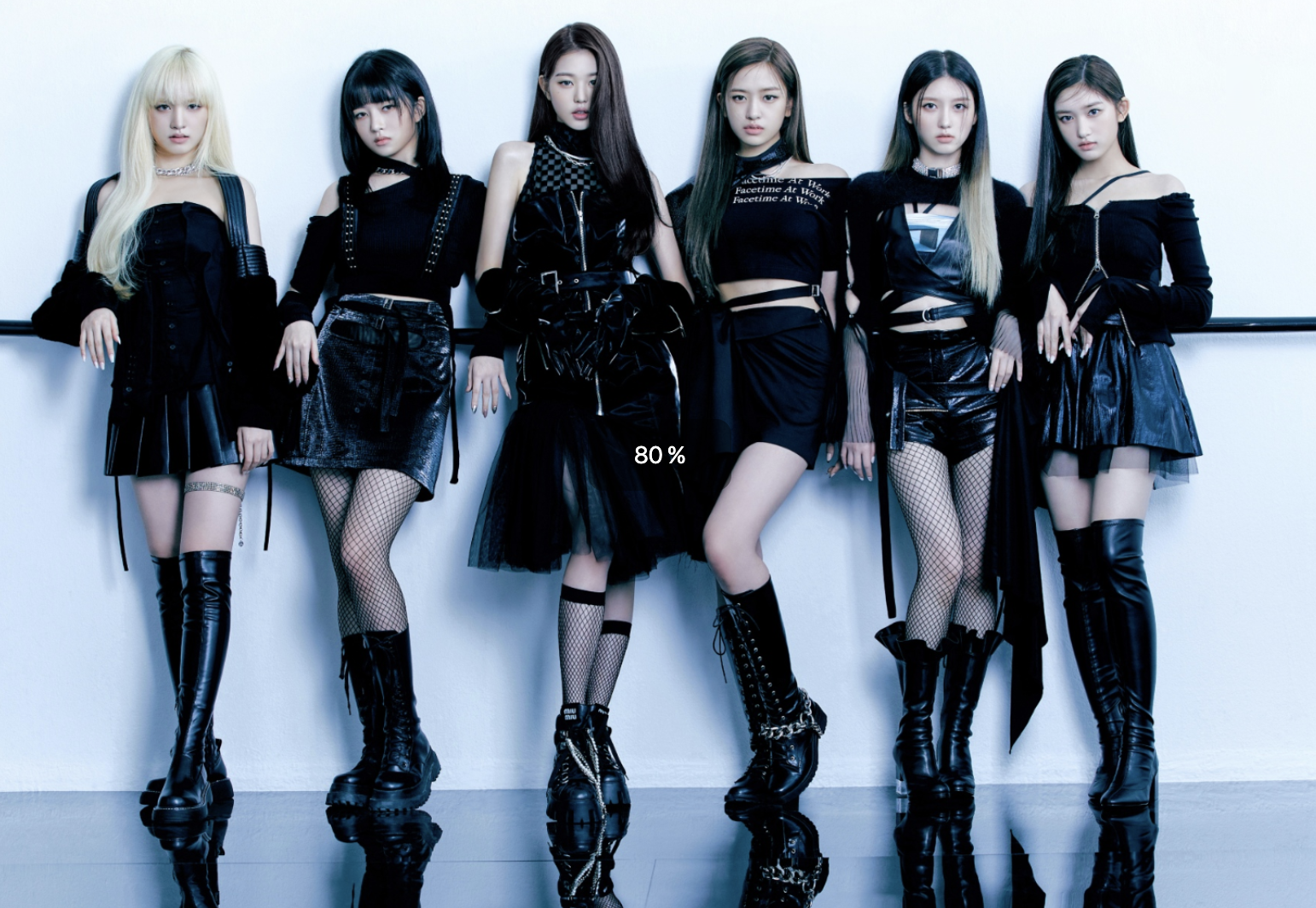
IVE recorded the strongest album sales among K-pop girl groups in 2025, selling over 2,468,408 copies. Their digital score also exceeded 7.4 million, solidifying their position as a group with both fandom power and mainstream appeal.
Their Japan-centered expansion strategy stands out. Of their 16 concerts, 11 were held in Japan, with 66.5% of total audiences concentrated there. Additionally, 97.9% of overseas album sales came from 11 Asian countries. For IVE, Japan is not just a market, but a strategic hub for expanding influence across Asia. Japanese member Rei plays a key role in strengthening local connection.
► A mega rookie chosen by Southeast Asia… Hearts2Hearts’ rapid establishment

Hearts2Hearts represents the most ‘new’ growth formula in the report. Among girl groups that debuted in 2025, they recorded the highest digital score at 1.61 million and album sales of 828,165, quickly rising to mega rookie status, an exceptional achievement for a new group.
Their growth was driven by explosive support from Southeast Asia. 68% of votes for the Rookie Award at the ‘Hanteo Music Awards 2025’ came from six Southeast Asian countries, with Indonesia (24%), Vietnam (19.3%), and the Philippines (17%) leading. Indonesian member Carmen’s presence translated beyond buzz into actual fandom formation and consumption.
Hearts2Hearts is no longer just a promising rookie, but a symbolic example of how strategically K-pop is approaching the Southeast Asian market.
► The winning formula for female K-pop artists in 2025 was ‘precision localization’
Ultimately, the conclusion of ‘Chapter 3: K-pop Woman Power Conquering Asia’ is simple. The growth of female artists in 2025 was not driven by a single dominant group, but by the sum of increasingly refined localization strategies. TWICE with ticket power, i-dle with member-driven regional focus, aespa with balanced performance, IVE with Asia-centered expansion, and Hearts2Hearts with Southeast Asia targeting each found their own answers.
The key takeaway is not merely the ‘rise of female artists.’ More precisely, it is a detailed blueprint showing how K-pop girl groups are now taking root in the Asian market and transforming country-specific fandoms into industrial performance. The woman power of K-pop in 2025 was not a victory of sensation, but a victory of structure—and that structure is already proven by numbers.
![[Daily Ranking: May 8th] CORTIS’s ‘GREENGREEN’ Places 1st](/_next/image?url=https%3A%2F%2Fhanteoresource.s3.ap-northeast-2.amazonaws.com%2Fhanteonews%2Farticle%2Fthumbnail%2Fbot%2Fchart%2Falbum%2Fdaily%2Fen%2F1st.png%3Fv0.0.1&w=3840&q=75)
![From PLAVE to KPop Demon Hunters... K-pop Beyond Dimensions [Hanteo Rewind Chapter 5]](/_next/image?url=https%3A%2F%2Fresource.hanteonews.com%2Fcontent%2Fpost%2F2026%2F05%2F01%2F6e0e2664-3e84-4fb5-b047-10cf14e0a6b2.jpg&w=3840&q=75)
